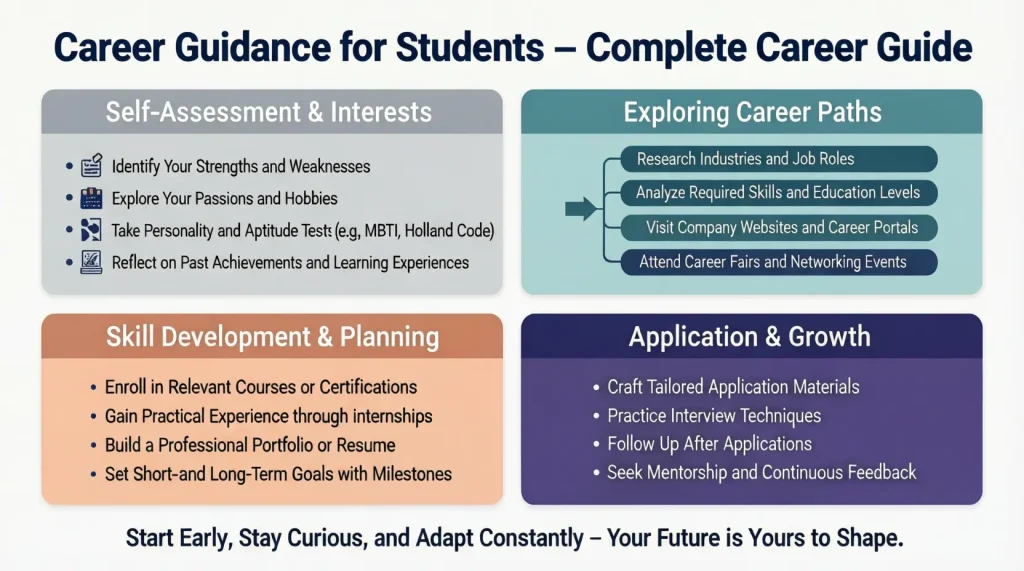
Choosing a career is one of the biggest decisions of early adult life, and it is usually made with the least information. Students are asked to pick subjects at fifteen, degrees at eighteen, and jobs at twenty-one, often based on little more than family expectations and a few familiar job titles. Good career guidance does not remove the uncertainty — nobody can promise you a perfect path — but it replaces guessing with a process. The career guidance tips below will help you understand yourself, explore the real world of work, and make decisions you can adjust as you grow.
Start With an Honest Self-Assessment
Before looking at job listings, look at yourself. Three questions matter most. What are you genuinely good at — not just what you scored well in once, but the abilities teachers, employers, and friends consistently notice? What do you enjoy enough to do for hours without watching the clock? And what does the market actually pay for? A satisfying career usually sits where those three circles overlap. Write your answers down. Many students skip this step and choose purely on salary or prestige, then wonder why they feel drained five years later. Strengths and interests are not soft considerations; they predict persistence, and persistence predicts success in almost every field.
Explore Careers Beyond the Obvious
Most people can name perhaps twenty occupations, yet modern economies contain hundreds. Beyond doctor, teacher, engineer, and lawyer lie roles like UX researcher, data analyst, logistics planner, medical coder, renewable energy technician, and content strategist — many of which barely existed a generation ago. Spend time reading real job descriptions, not to apply, but to learn what roles involve day to day. Watch “day in the life” interviews, attend career fairs, and talk to people working in fields that interest you. A twenty-minute conversation with a practitioner is worth weeks of speculation, and most professionals are flattered to be asked. Keep a shortlist of three to five directions rather than fixating on a single dream job too early.
Build Skills That Travel Between Careers
Specific job titles rise and fall, but certain skills remain valuable everywhere: clear writing, confident speaking, basic data literacy, problem-solving, and the ability to learn new tools quickly. Whatever field you choose, invest deliberately in these. Short courses, volunteering, part-time work, and personal projects all count — often more than students realise. When you research training options, apply the same care you would to any significant decision; detailed comparisons such as guides weighing features, benefits, pricing and safety exist for many online services, and your education deserves at least that level of scrutiny. Employers consistently report that attitude and transferable skills matter as much as the degree subject itself.
Get Experience Before You Graduate
Experience is the fastest way to test a career idea. Internships, apprenticeships, shadowing days, freelance tasks, and even running a small society or online project all reveal whether the daily reality of a field suits you. They also solve the graduate’s classic dilemma — every job wants experience, but nobody will give you a first chance — by letting you graduate with evidence already on your CV. Treat every placement as an interview in both directions: you are assessing them as much as they are assessing you. Keep notes on what energised you and what bored you; patterns in those notes are some of the most reliable career guidance you will ever receive.
Make a Plan, Then Review It Yearly
A career plan is not a life sentence; it is a working document. Sketch where you would like to be in one year, three years, and five years, and identify the next concrete step for each horizon — a qualification to finish, a skill to build, a contact to make. Then review the plan every year. Industries change, new interests emerge, and opportunities appear that nobody could have predicted. The people who navigate change best are not those with the most rigid plans but those who keep their direction while adjusting their route. If your plan depends on signing up for platforms, programmes, or services, read the safety and access details first — resources like complete guides covering access, risks and alternatives are a reminder that every opportunity deserves a careful look before you commit your time or money.
Questions to Ask at Every Career Crossroad
Careers are not chosen once; they are re-chosen at every crossroad — the first job, the promotion declined, the industry that shrinks, the offer in another city. At each of those moments, a short set of questions will serve you better than panic or impulse. What does this option teach me, and is that learning valuable beyond this employer? What does it cost — not only in salary terms, but in time, energy, location, and the parts of life that compete with work? What does it make possible next: which doors does it open, and which does it quietly close? And finally, am I choosing this, or am I drifting into it because it appeared? Drift is the most common career strategy in the world and the least reliable. People who pause at crossroads and run these questions — in writing, ideally, with a trusted person challenging their answers — make decisions they can explain to themselves years later. That ability to explain your own path is worth a great deal, in interviews and in life.
Use the Guidance Available to You
Finally, do not plan alone. School and university career services offer aptitude assessments, CV reviews, mock interviews, and alumni networks — most of them free, and most of them underused. Mentors, whether formal or informal, shorten your learning curve by years. Family and friends can offer support, but balance their advice with information from people actually working in your target field. Career decisions feel heavy because they are long-term, but they are also reversible in ways students rarely appreciate: people retrain, pivot, and reinvent themselves at every age. Start with self-knowledge, explore widely, build portable skills, gather real experience, and keep your plan alive. That is career guidance you can use for the rest of your working life.